
Manual / Reading the numbers
Every diversion figure is an estimate
- For
- a controller or planner reading a diversion record
- Status
- current
- Covers
- the
~mark, in the Diversions tab and in every document it produces - Last checked against the app
6f7727e(2026-08-19)
The Diversions tab prints a leading ~ on every figure it worked out for
itself, and prints nothing in front of the figures it counted. That single
character is the whole claim, and it is on screen everywhere the figures are.
What you are looking at
The header of the Diversions register says it, first thing:
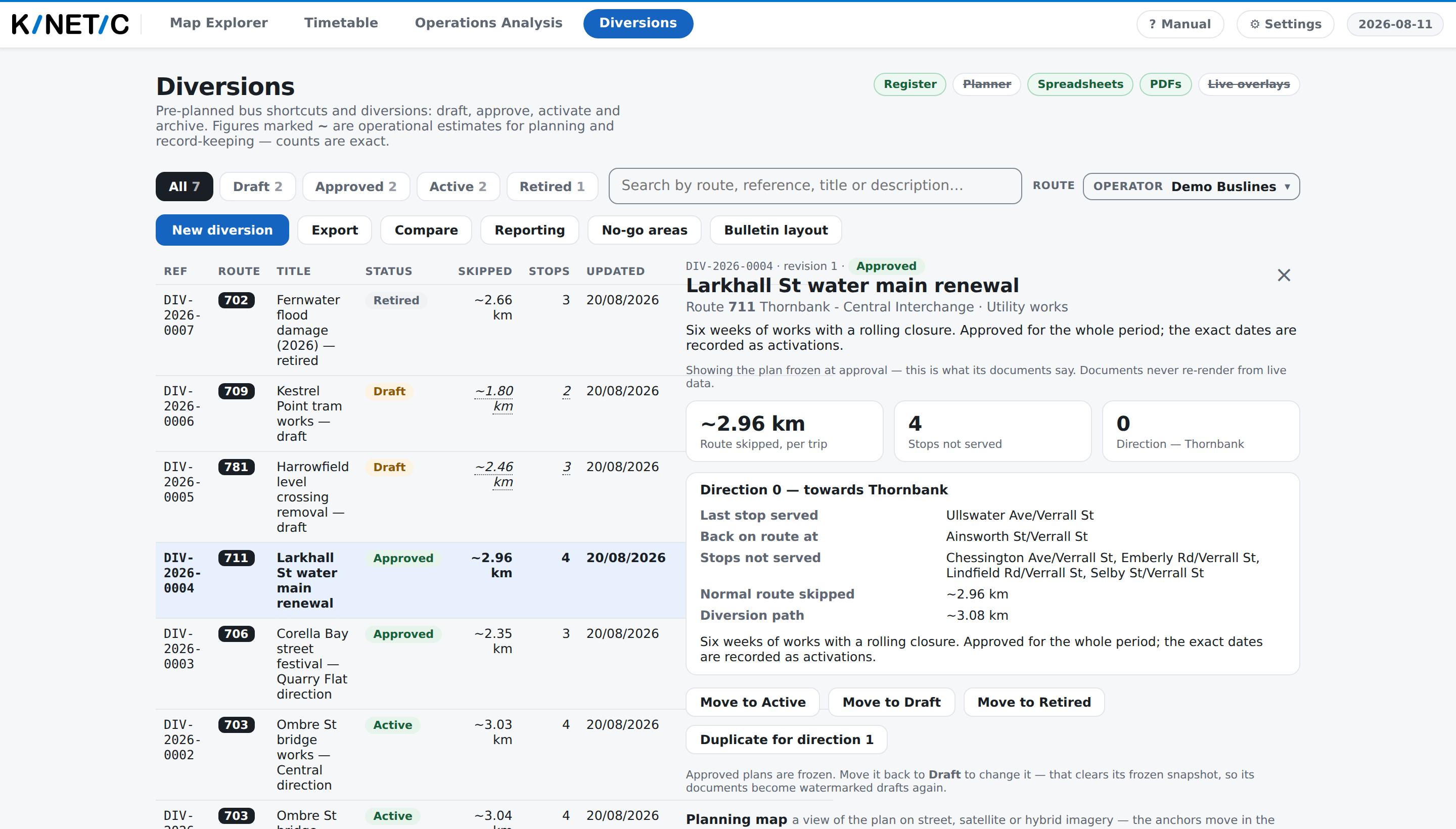
Pre-planned bus shortcuts and diversions: draft, approve, activate and archive. Figures marked ~ are operational estimates for planning and record-keeping — counts are exact.
The comparison view repeats it, and every document the tab produces carries the same sentence in full:
Figures marked ~ are operational estimates for planning and record-keeping. Service-km not operated is estimated from the plan and the timetable, and is frozen when an activation is recorded so a past window keeps the numbers it was recorded with. Counts are exact for the plan as drawn.
Which is which
Marked ~ — an estimate |
Plain — an exact count |
|---|---|
| Route skipped, per trip and Normal route skipped — how much of the normal route is not driven | Stops not served |
| Diversion path — how long the detour is | Trips on screen, Trips affected in a document |
| Estimated drive time, and the per-band comparison against the timetable's own allocation | Service days |
| Service-km lost wherever it appears, including the reporting table and the spreadsheet | Direction, and the stop names either side — Last stop served and Back on route at |
| The distance to the next turn on a driver instruction, and each turn's drive time |
In the spreadsheet the mark moves into the column heading — Service-km lost (~ estimate) — so that the cells underneath stay numbers you can add up.
Why the counts are not marked
A ~ on a count would claim a doubt this tool does not have, which is its own
kind of wrong label. Given where the anchors are and what the timetable says, the
list of stops between them is not an approximation — it is the list. Marking it
would teach a reader to discount something exact, which is exactly as misleading
as not marking something inexact.
The same rule runs the other way twice more:
- A dash stays a dash. Marking "we do not know" as approximate says nothing,
so a missing figure prints as a plain
—and never as~—. - A stated bound is already an estimate. A driver instruction reads then under 10 m, not then ~under 10 m, because three hedges stacked on a distance a driver reads as "right here" is worse than one.
What they do not mean
None of this is contract-reportable data. The tool is operational. Nothing it produces is designed to be quoted in a performance regime, and the framing that once said otherwise was withdrawn deliberately, not softened.
"Service-km not operated" is scheduled service, not observed service. It is what the timetable said would run over that window, against the plan as drawn. It is not what the buses actually did — this app knows that only where an official export of observed running has been loaded, and never for a diverted trip, because a diverted trip is by definition not the trip the export measured.
It is frozen at the moment an activation is recorded, and that is a feature. Two activations of the same diversion in different months can report different kilometres for the same closure, and be right both times, because the timetable changed in between. A past window keeps the numbers it was recorded with rather than being quietly re-estimated against today's schedule — that would replace history rather than preserve it.
A total is only as good as what went into it. The reporting table sums frozen per-activation estimates. It inherits their accuracy and nothing more; summing does not make an estimate a measurement.
A blank service-km figure is not zero. Where a record cannot be resolved the
figure is absent with a note, not 0.0. Zero kilometres and an unanswerable
question are very different statements about a closure.
The drive time is a planning signal, not a running time. The tab says so under the figure: it comes from a routing engine assuming free-flowing traffic and no time spent at stops. It is there to tell you one detour is longer than another, not to tell you when a bus will arrive.
The estimate does not colour anything. Service-km not operated is a magnitude, not a classification. It is not a delay band, not a headway band and not a road severity band, and nothing on the map changes colour because of it.
A diversion record is not an instruction to anybody. Producing the paperwork here does not issue it. What goes out, goes out by whatever route your control room already uses.